SCHOLARSHIPS & AWARDS

Articles

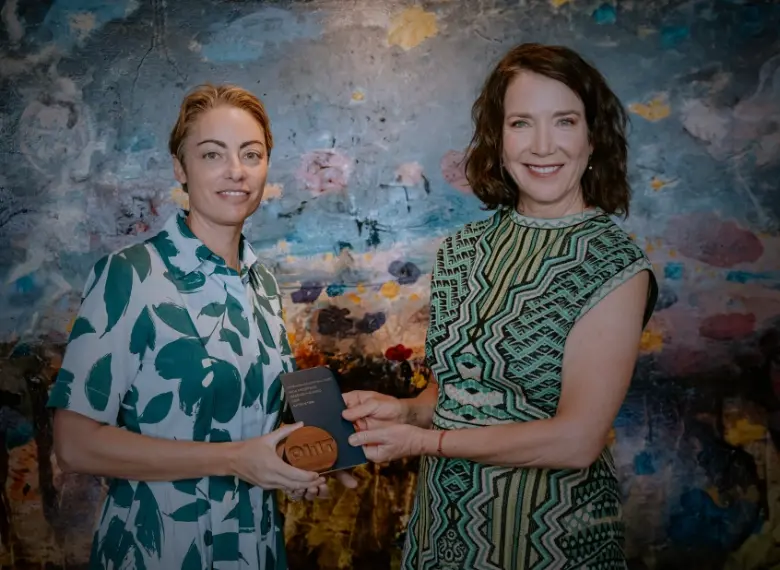
Dr Katye Altieri awarded the 2025 New Frontiers Research Award
What is air pollution’s impact on climate change? OMT New Frontiers Research Award 2025 winner aims to find out.


Research Report


Featured
Does air pollution-derived nitrogen improve our oceans’ ability to remove greenhouse gases from the atmosphere – or does it create an even worse situation?
Finding out this vitally important, but as yet unknown, component in the global response to climate change will be the mission of Dr Katye Altieri, winner of the Oppenheimer Memorial Trust’s New Frontiers Research Award for 2025.
Altieri, an Associate Professor in Oceanography at the University of Cape Town (UCT), was announced as the second ever winner of the five-year, R7.5-million award at a function in Johannesburg on 12 May 2025. Her proposal pipped 175 other entries, which included such disciplines as astrophysics, visual arts, food security, ecology, paediatric immune diseases and neuroscience, to the award.
The Oppenheimer Memorial Trust (OMT) instituted the award in 2024 (the inaugural grant also went to a UCT scientist, particle physicist Dr James Keaveney), in response to a need to bolster South Africa’s global reputation for research excellence, and attract and retain early- to mid-career researchers who will build diverse, high-performance research teams, foster collaboration and strengthen the South African academy. It aims to give exceptionally talented researchers the freedom and flexibility to pursue bold ideas, and push the boundaries of knowledge
“We must support South African academia with the resources they need to compete globally and contribute knowledge that changes our world for the better,” says Oppenheimer Memorial Trust chairperson Rebecca Oppenheimer.
“Dr Altieri is precisely the kind of researcher we envisage for the award. Her idea, examining the relationship between the atmosphere, atmospheric pollution and the oceans, is certainly bold and it addresses a significant gap in our knowledge of how the air pollution we create impacts climate change.
“We’re thus delighted to present the 2025 New Frontiers Research Award to Dr Altieri, and we’re very excited to hear her findings.”
Professor Jeff Murugan, the Acting Deputy Vice-Chancellor for Research and Internationalisation at UCT, has thanked OMT for its “visionary support” for early- and mid-career researchers at a time when science, in particular climate science, is facing challenges.
He points to the fact that both New Frontiers Research Awards to date have gone to UCT researchers, and that their work indeed represents diverse research frontiers: on the subatomic particle front for Keaveney, and in the vastness of our oceans for Altieri.
“We are immensely proud of our researchers at UCT, in particular Dr Altieri … We’re dedicated to research that matters.”
Altieri, an atmospheric chemist by training, has devoted most of her career to date to this question. It is known that our oceans help to remove the greenhouse gas carbon dioxide (CO2) from the atmosphere – and that nitrogen helps the oceans to do that. However, nitrogen can spur the production and release of nitrous oxide (N2O), another greenhouse gas that is 300 times as potent as CO2.
“We have doubled the amount of nitrogen in the atmosphere through activities such as fossil fuel combustion and agriculture. That nitrogen, even from far inland, is swept out to sea and settles in the ocean,” she says.
“But we don’t know exactly how much pollution-derived nitrogen reaches the open ocean, and we don’t know exactly what happens when it ends up in the ocean: does it increase the ocean’s ability to remove greenhouse gases from the atmosphere, or the emission of much more deleterious N2O into the atmosphere?”
The principal reason for this knowledge gap is because scientists – in this case, atmospheric chemists and oceanographers – tend to work in silos and not together, which is reflected in governments’ climate change policy frameworks.
“As an atmospheric chemist and an oceanographer, I intend to help change that by forging new ways of scientific thinking about both our atmosphere and our oceans, helping us to build knowledge in ways we haven’t before,” says Altieri. This multidisciplinary approach will inform governments’ climate change policy frameworks going forward.
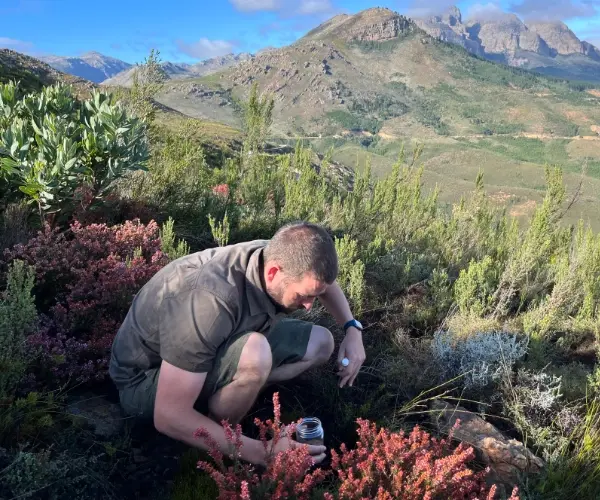
She continues that South Africa is the ideal location for this research, as the country is a leading emitter of air pollution and provides access to three diverse ocean systems: the nutrient-rich, cold Benguela current up the west coast of Africa; the ocean desert of the South Atlantic Ocean, which is comparatively nutrient-poor and has limited marine life; and the “time machine” that is the Southern Ocean, which boasts as close to the pre-industrial atmosphere as anywhere on Earth.
“Being able to measure and compare these environments will be invaluable to our research. Added to this, we have access to the world-class polar research vessel, the R/V S.A. Agulhas II, which allows for research operations in these diverse ocean regions,” says Altieri.
“While South Africa is the springboard, the integration between the atmosphere and the ocean is, from a scientific perspective, inherently global. So what we learn from the oceans around South Africa will have bearing on our entire planet.”
Research Report


Featured
+27 (0)11 551 9500
Ground Floor
The Reserve
54 Melville Road
Illovo, 2196
Johannesburg
South Africa
Our Focus Areas

.png)
© 2023 The Oppenheimer Memorial Trust
Terms of Service | POPIA