SCHOLARSHIPS & AWARDS

Articles

Dr James Keaveney wins inaugural New Frontiers Research Award
New Frontiers Research Award promises academic excellence, freedom – and solutions.


Research Report


Featured
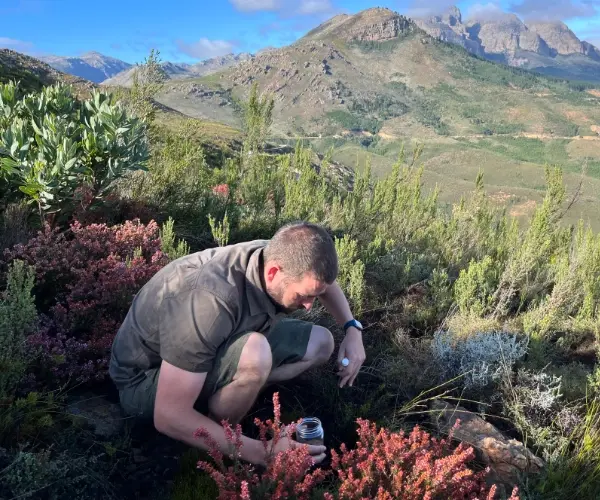
University of Cape Town particle physicist, Dr James Keaveney, received the Oppenheimer Memorial Trust’s (OMT) inaugural New Frontiers Research Award, aimed at supporting and reinvigorating South Africa's reputation for research excellence, on 15 May 2024.
“We are thrilled to launch this award. The annual New Frontiers Research Award aims to give exceptionally talented early- to mid-career researchers the freedom and flexibility to pursue bold ideas and push the boundaries of knowledge in their fields of study,” says OMT chair Rebecca Oppenheimer.
The total award is for R7.5-million. The winner, who receives R1.5-million in research funding each year for five years, must be based at a South African university and have the ambition needed to build high-performance teams.
Keaveney says he is excited by the task he has set himself: “It’s living your dream to be paid to explore, [but] it’s not often that, as a scientist, you are given free rein to pursue exactly what you want to pursue.”
“OMT believes that the New Frontiers Research Award is a step towards the substantial investment in research excellence and innovation that is needed to put South Africa back on the path to prosperity,” says Oppenheimer. The Trust also hopes the award becomes a model for supporting and growing research excellence in South Africa, attracting funding from other philanthropists and the private sector.
OMT’s research reveals that many of South Africa’s highly skilled career researchers are leaving academic research due to limited public funding for universities, postgraduate studies and research. Some go into the private sector, others are lost to better-funded research institutions abroad. This is putting the well-deserved global research reputation of South Africa’s leading universities at risk, OMT says in its 2023 Education Research Report.
OMT has an extensive history of funding masters and doctoral studies as well as postdoctoral and sabbatical research. The trust’s most prestigious award, the Harry Oppenheimer Fellowship Award is aimed at established academics of the highest calibre. The New Frontiers Research Award targets early- to mid-career researchers, filling a critical gap in research funding. This also enhances OMT’s higher education portfolio, now providing support for the full postgraduate academic journey.
Universities contribute to a country’s economic prosperity by producing research and attracting brilliant thinkers who will drive innovation that solves socio-economic challenges. South Africa’s universities’ ability to fulfil this role has been eroded over the past decade because their core funding has been cut, or has not kept pace with the rise in student numbers or inflation.
Of the 101 initial applicants, Keaveney was one of only eight who were called to be interviewed. Applications came from all corners of South Africa and a range of subjects, from English to astrophysics. “The panel members, consisting of some of South Africa’s leading academics, were extremely impressed with the range and quality of applications received,” Oppenheimer says.
Keaveney is a well-published, often-cited research physicist. He is also the elected national coordinator of a group of almost one hundred South African physicists and engineers who collaborate in ATLAS, a multinational general-purpose particle physics experiment at the European Council for Nuclear Research (CERN) in Geneva, Switzerland.
He will use the New Frontiers Research Award to “apply the rigorous methodologies and techniques developed in fundamental particle physics to real-world problems”, especially at the cutting-edge of low-cost medical imaging, in cancer research.
Keaveney hopes to develop ways of making positron emission tomography (PET) scanning more effective and cheaper. PET scanning is highly sensitive, able to pinpoint cancers and other tissue damage, making it essential for cancer diagnosis and monitoring. It is also used in tuberculosis (TB) diagnosis and treatment. TB is the leading cause of death in South Africa and the leading infectious killer of people worldwide after Covid-19.
Due to expense, PET scanning is often simply not available in middle- and low-income countries like South Africa. Keaveney wants to develop the use of microscopic objects (quantum-dot nanocrystals) as the sensitive detector elements at the heart of a PET scanner. They dramatically boost PET efficiency, expanding its use from cancer to cardiovascular, infectious diseases, stem-cell tissue repair, inflammation, paediatric, and prenatal fields. They are also more cost-effective than current materials.
Keaveney also plans to use the award to promote global interdisciplinary collaboration, which he views as “key to expanding the horizons of particle physics”, and to develop younger, up-and-coming scientists in this field. In his work, he will particularly collaborate with experts in artificial intelligence and machine learning, and in nano-electronics at UCT, at the African Institute for Mathematical Science (AIMS), at CERN, and at institutions around the world.
“This project will unambiguously break new ground in the field of detector technology,” he says, speaking of his aim to develop quantum dot-based scintillator detectors with ultra-fast response times.
“James Keaveney impressed everyone on the committee not only with his science, but also with his ability to explain very complex concepts in physics and medicine. He made his science practical and relatable and, importantly, emphasised how his invention could make scanning technologies more affordable and accessible to people in Africa,” says Professor Lynn Morris, Deputy Vice-Chancellor: Research & Innovation at the University of the Witwatersrand. Morris is one of the adjudicators of the New Frontiers Research Award.
“We are extremely proud of Dr Keaveney’s receipt of the inaugural New Frontiers Research Award. This recognition of his achievements provides a further example of the contributions of our researchers to the advancement of both knowledge, with an impact both local and global”, said Professor Daya Reddy, Vice-Chancellor interim at UCT.
"We are also confident that this prestigious award will provide further impetus to his research efforts, pave the way for new knowledge, and contribute to future innovations,” Professor Reddy added.
Research Report


Featured
+27 (0)11 551 9500
Ground Floor
The Reserve
54 Melville Road
Illovo, 2196
Johannesburg
South Africa
Our Focus Areas

.png)
© 2023 The Oppenheimer Memorial Trust
Terms of Service | POPIA